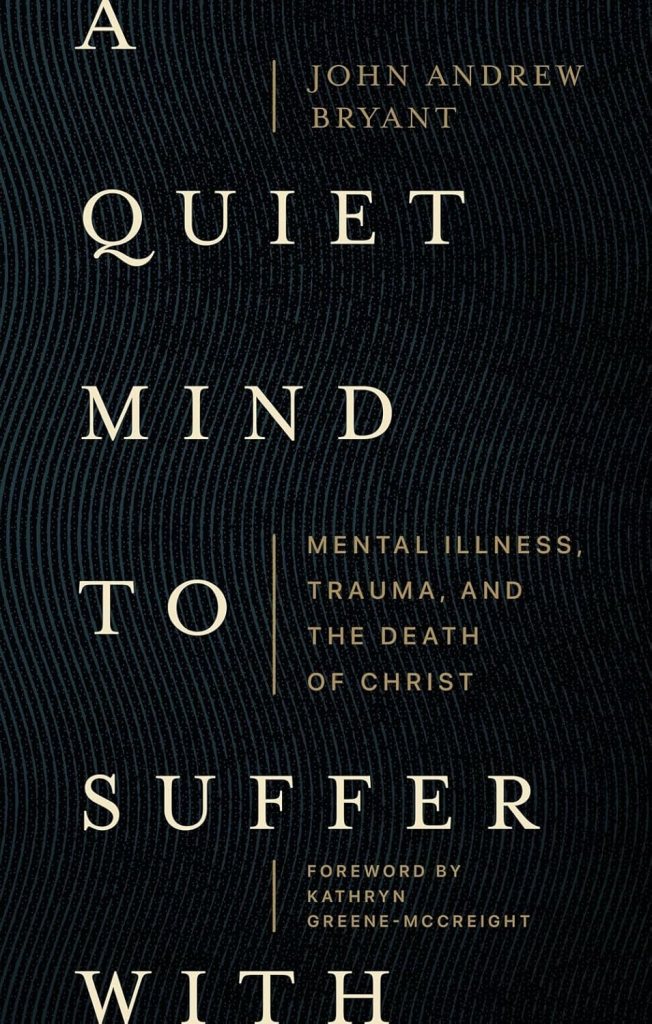
Summary
A Quiet Mind to Suffer With: Mental Illness, Trauma, and the Death of Christ by John Andrew Bryant is about his journey with obsessive-compulsive disorder (OCD). It is a stunning, thought-provoking meditation on the gospel and resting in Christ’s mercy, specifically in light of OCD, but really applicable to everyone.
Critiques
The writing rambles and wanders and was sometimes too poetic for me. But at the same time, I think the writing style was just what it needed to be, to give the reader little bits at a time to sit with and think about, to have repeated thoughts and phrases to bring back to my own mind when it was disquieted.
I do have a few quibbles here and there with the potential theology behind some comments, but with how poetic it is I’m not entirely sure. It tends to be about sin, such as when he says “sin is not a thought or feeling” (175), which in the context of OCD can be a helpful statement if you’re saying intrusive thoughts aren’t sin, yet broadly speaking, we can and do sin in thoughts and feelings. Bryant doesn’t avoid the issue of sin in OCD, as he repeatedly talks about the problem of self-dependence, seeking to control and fix things ourselves instead of trusting Christ. His book isn’t a theological treatise of the question of how sin and mental illness intersect, but it does touch on that question in a way that for the most part I think is exceptional.
Highlights
If you have no context for OCD, Bryant’s book may be confusing, startling, and you may not understand some of his theology. At the same time, this book is extremely valuable for those who don’t have OCD or any sort of mental illness, because it gives you a glimpse of what it’s like to live in that land, especially to live there as a Christian who trusts the Lord, believes the gospel, does all the “right things,” and is still assaulted by “the Siren,” as Bryant calls it.
And what a term, calling it the Siren. I don’t have OCD right now, but I had it postpartum, and have some OCD-like tendencies that flare up occasionally. And to be able to talk to myself to tell myself not to trust the Siren, to talk to God in prayer and grow in trust in him instead, to let his mercy reign and not the Siren, to let my memory be transformed, because he shepherds you through it, to be quiet because he makes it ok, to let his grace overrule my self-dependence and the lie that I can fix things, to live in terms of what’s been given and what’s been promised… Bryant has given many a gift in this book.
It’s a gift to those who have OCD to know someone else knows what it’s like and to provide an example of faith and believing the gospel amidst it. It’s also a gift to those who have OCD because it’s something they can share with loved ones who don’t understand.
Bryant really highlights what it means to walk by faith, to live when mental illness doesn’t improve, to rest in Christ amidst affliction. If anyone tells you that those with mental illness have less faith—hand them this book, because you’ll see his on display.
Really, this book is about how to let Christ be “the clothing of our shame. The casting out of our fear. The overturning of accusation. The bearing of History. The enduring of Affliction. The burial of the Hardness of the Heart” (33), so that we know we don’t have to do anything to be ok, but something has been done so that we are ok, and that something is a reality even when the Siren is telling us something else.
“In a world where we can’t know What Could Happen, or control What Should Happen, the option was always available to depend on Christ and head toward my dependence on Christ” (75).
Who it’s for:
- Anyone who wants to meditate more on the gospel and what it means to rest in Christ’s mercy.
- Those who are learning to live with OCD or process after a bout of postpartum OCD.
- Those walking alongside someone with OCD, to better understand what they’re going through.
Theological Perspective
While not every Christian will agree with everything in it (I noted my reservations above), Bryant’s book is explicitly Christian, Christ-centered, and has the potential to influence a believer’s spirituality very positively.
 The Sorrows of Eve